
If «smart customer service» defined aviation AI over the past two years, this year the keyword has become the «AI Agent». From China Eastern's full-flight booking agent built with Tongyi Qianwen, to Korean Air, KLM BlueBot and AirAsia AVA; from Xiamen and Fuzhou airport AI concierges to Trip.com's «Wendao», Fliggy and Tongcheng DeepTrip — AI is moving from answering questions to completing tasks.
On the Airline Side: From Q&A to Task-Completion
Airline AI is undergoing a qualitative leap. China Eastern's full-flight agent connects natural language and intent recognition directly with the booking engine — just say «book the earliest Shanghai-to-Beijing flight next week» and the agent completes it. Korean Air and Air France-KLM (with Google Cloud) embed generative AI across purchase, rebooking and baggage. Pioneers like KLM BlueBot (2017) and United's Agent on Demand proved the concept; now AI has finally closed the loop on execution.
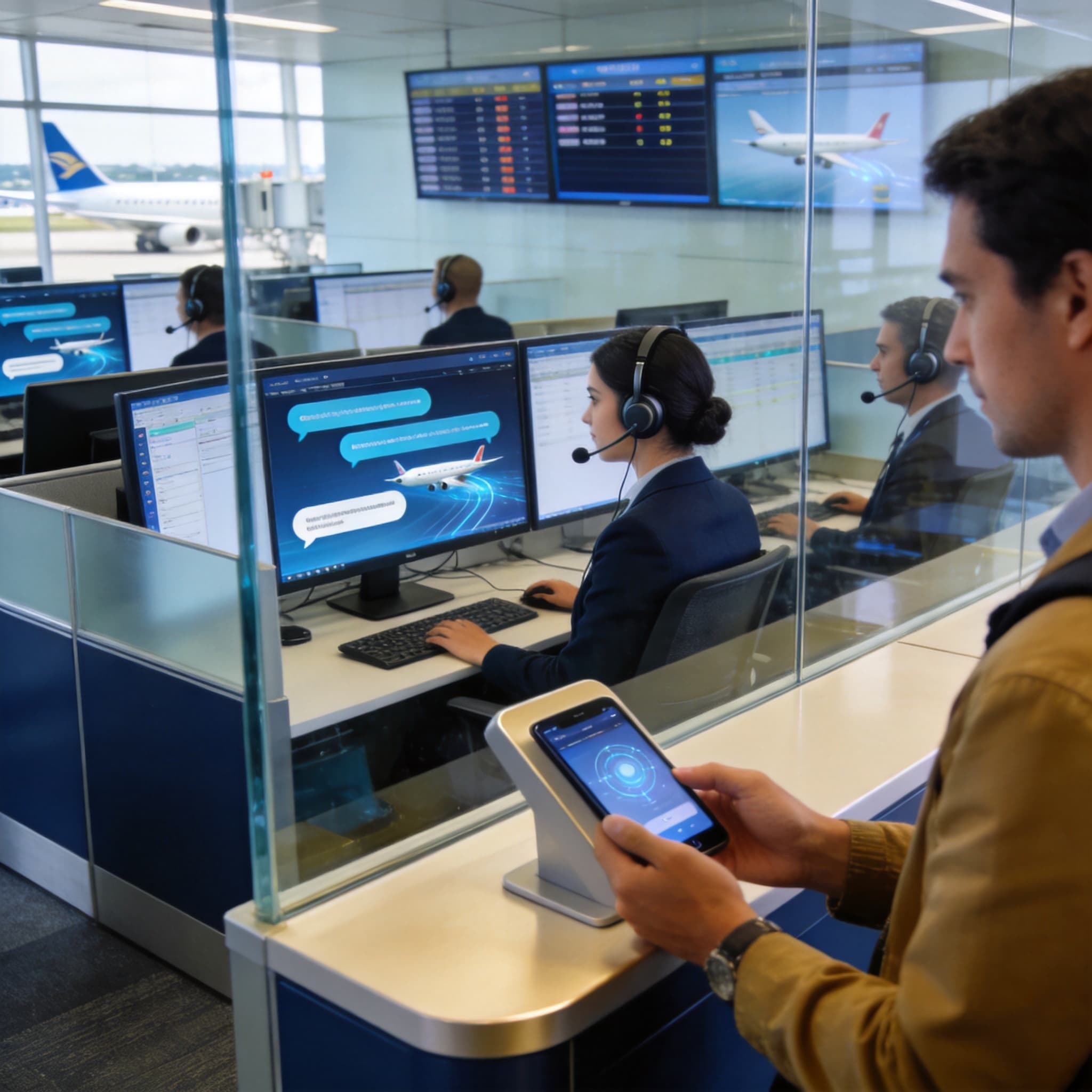
- ✓China Eastern × Qianwen (2026): full-flight booking via natural language
- ✓Korean Air AI assistant (2026): deep booking & rebooking integration
- ✓Air France-KLM × Google Cloud (2024): generative AI across service journeys
- ✓KLM BlueBot (2017): the pioneer of conversational airline service
- ✓Cathay, AirAsia AVA, United Agent on Demand: multi-channel assistant matrix
On the Airport Side: From Digital Twins to Face-to-Face Digital Humans
Airports take a different path — «extreme operations plus face-to-face service». Xiamen and Fuzhou's AI digital concierges handle flight inquiries, terminal navigation and special-assistance summoning, freeing human staff from repetitive work. On the operations side, Shanghai Airport's «Airport Brain + Digital Twin» and Guangzhou Baiyun's smart screening use AI to make every runway, baggage, boundary and security link predictable. This is the tipping point from scheduling to real-time decision-making.

T-AGENT: A Travel Concierge That Plans, Decides and Executes
If airline and airport agents are «point intelligence», OTA travel agents (T-AGENT) are global concierges spanning flights, hotels and itineraries. Trip.com's «Wendao» / Trip Assistant (2023) pioneered multi-turn conversational booking; Fliggy launched the interactive «AI host Nezha»; Tongcheng DeepTrip (2026) injects deep reasoning into planning; Booking.com's AI Trip Planner serves travelers worldwide. And in open source, multi-modal agents like TraveLLaMA are moving travel planning from research labs into reusable engineering.
- ✓Trip.com Wendao / Trip Assistant (2023): conversational booking
- ✓Fliggy AI itinerary assistant & AI host Nezha: persona-driven concierge
- ✓Tongcheng DeepTrip (2026): deep reasoning in planning
- ✓Booking.com AI Trip Planner: global itinerary generation
- ✓Open-source TraveLLaMA: multi-modal travel agent research
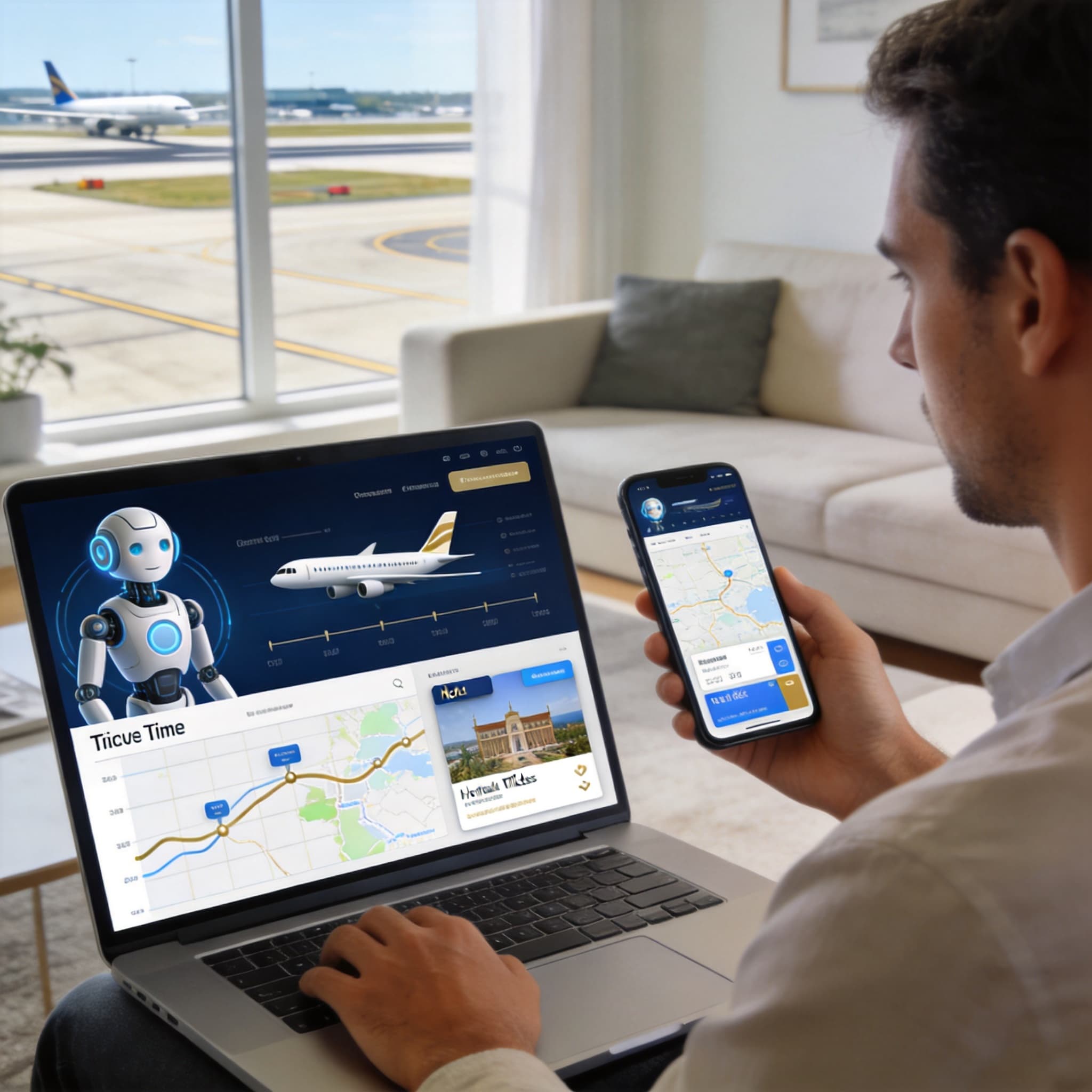
The OTA Race: Re-platforming the Traffic Entry via Agents
OTA is the fiercest battlefront of aviation AI, because its core asset is the entry point. Once a traveler can get a complete itinerary from a single sentence instead of paging through searches, comparisons and bundles, whoever makes the agent the default entry controls both traffic and bookings. China's Trip.com, Fliggy and Tongcheng, plus global Booking, Expedia and Skyscanner, are all pushing LLMs into search, recommendation, service and dynamic packaging. This is a paradigm shift from shelf-based to conversational entry — comparable to mobile apps replacing desktop web.
- ✓The entry battle: conversational AI displacing the search shelf
- ✓Dynamic packaging: agents auto-composing flight + hotel + activities
- ✓Supply-chain reshaping: direct inventory, fewer distribution layers
- ✓Business models: from pay-per-click to pay-per-booking/dialog
The Open-Source Wave: Aviation AI Is Taking Shape on GitHub
Zoom out to GitHub and the picture gets even more exciting: aviation AI has crossed the demo threshold into the engineering phase. AWS's official Serverless Airline Booking (2.3k stars) turns airline booking into complete microservice blueprints; LetsFG (2k stars) lets agents search and book flights and hotels directly; ai-travel-agent (799 stars) enables natural-language flight booking; azure-ai-travel-agents builds enterprise travel agents on MCP. On the data side, FlightAirMap and opensky-api turn global ADS-B flight data into visualized, queryable APIs — the real-time «perception layer» for travel agents.
- ✓aws-samples/aws-serverless-airline-booking: 2.3k stars, booking microservices
- ✓LetsFG/LetsFG: 2k stars, agents booking flights & hotels directly
- ✓nirbar1985/ai-travel-agent: 799 stars, multi-model natural-language flight agent
- ✓Azure-Samples/azure-ai-travel-agents: enterprise travel agents on MCP
- ✓Ysurac/FlightAirMap + openskynetwork/opensky-api: global real-time flight data layer
- ✓jjasghar/ai-airport-simulation: LLMs making real-time decisions in a simulated airport
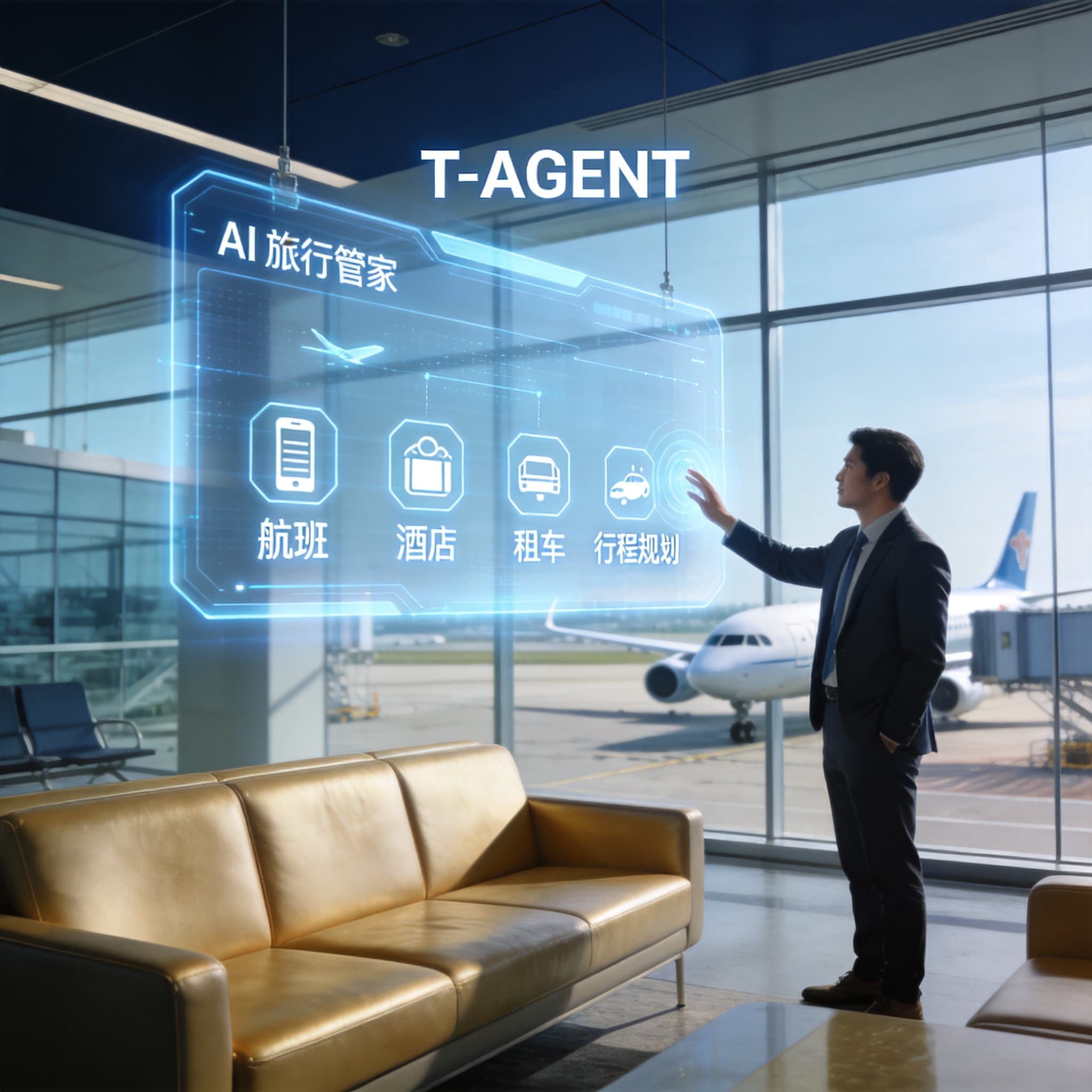
The Harder Frontier: T-AGENT Enters Corporate Travel Management (TMC)
If consumer-facing concierges compete on experience, corporate travel management (TMC) is the harder and more valuable frontier for T-AGENT. Business travel is not a spontaneous individual trip but a policy-constrained workflow: requests need compliant approval, flights and hotels must sit within negotiated rates and travel policy, disruptions demand instant rebooking, and afterwards invoices, itineraries and card statements must be auto-reconciled into expense reports. This chain used to rely on travel consultants, admins and finance staff; T-AGENT can now orchestrate policy rules, supplier inventory, approval flows and settlement systems in one go.
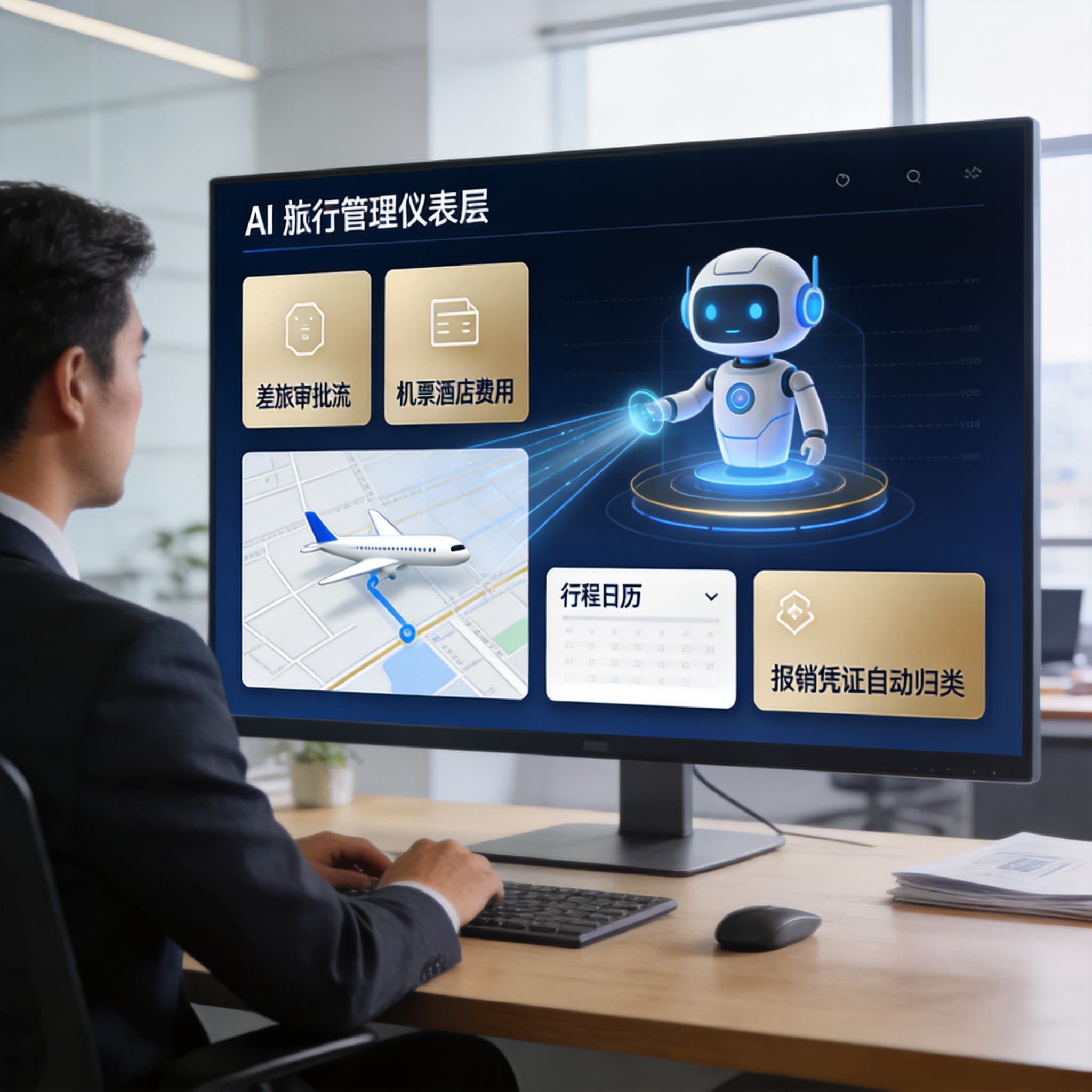
Three capability barriers define TMC's moat versus ordinary OTAs. First, compliance-as-execution: the agent embeds corporate travel policy into recommendations — economy class, preferred hotels, seven-day advance booking — with over-policy choices auto-routed for manager approval rather than rejected later by finance. Second, supply-chain depth: it must connect directly to GDS, airline NDC, negotiated hotels and car services to access corporate rates and inventory, not just public price-comparison APIs. Third, closed-loop settlement: trip data flows straight into ERP and expense systems (SAP Concur and similar), achieving book-to-ledger and trip-to-reimbursement without manual receipt handling.
- ✓Before travel: natural-language request, policy check, negotiated rates and auto approval
- ✓During travel: real-time disruption detection, proactive rebooking and itinerary sync
- ✓After travel: invoices, itineraries and payments auto-matched into compliant expenses
- ✓For management: spend visibility with AI-driven savings and supplier negotiation insights
Commercially, TMC revenue comes not from consumer subsidies but from service fees, supplier rebates and savings-share — with strong stickiness and high switching costs. Microsoft is embedding meetings and travel into Copilot, while SAP Concur, Amex GBT, Navan and players across China are pushing LLMs into this chain. For T-AGENT, whoever makes compliance, supply chain and settlement auditable, accountable and error-free wins the higher-margin, stickier enterprise ticket.
Deep Dive: The Four-Layer Value Chain and the Redistribution of Value
Placing airlines, airports, OTAs and T-AGENT on one map reveals a clear four-layer value chain, and AI agents are redistributing value between every layer. At the bottom is the data and infrastructure layer — GDS, real-time ADS-B data, airline NDC APIs, payments and identity — defining what agents can sense and call. Above sits the supply layer: airlines with seats, airports with operations and ground handling, hotels and cars — the most asset-heavy and hardest-to-replace layer. Next is the aggregation and distribution layer of OTAs, TMCs and metasearch that bundle and distribute fragmented inventory. At the very top is the intelligent-entry layer — the T-AGENT every player is now fighting to own.

The central tension is entry power moving up while margin pressure moves down. As travelers get used to stating needs to an agent, control over comparison and choice shifts from the OTA shelf to the agent's recommendation algorithm. For OTAs this is both opportunity — becoming the default entry — and threat, as upstream system assistants (device makers, office software, enterprise Copilot) may intercept traffic. For airlines, agent-direct NDC offers a route around steep distribution fees to reclaim customer relationships; airports evolve from landlord-style traffic venues into creators of value from operational efficiency and commercial data.
- ✓Supply (airlines/airports): reclaim customers via NDC-direct and agents, cut distribution cost
- ✓Distribution (OTA/TMC): become the agent entry or risk being commoditized by system assistants
- ✓Entry (T-AGENT): own intent understanding and recommendation, reshaping traffic and orders
- ✓Data: real-timeness, callability and open protocols like MCP become the new battleground
The endgame will not arrive overnight; three hard constraints remain. First, reliability and accountability: air tickets are high-value, rule-bound transactions where a wrong rebooking or duplicate issuance costs far more than a wrong sentence — agents must be auditable, rollback-capable and human-backed. Second, openness of data and APIs: much inventory and refund/change rules remain locked in heterogeneous systems, and real-time coverage and accuracy set the ceiling for agents. Third, trust and habit: entrusting passport, payment and itinerary to AI requires long-built confidence in privacy, security and certainty. Only after crossing these three barriers will T-AGENT evolve from a handy assistant into indispensable infrastructure.
Outlook: From Point Intelligence to an Aviation AI Operating System
Following this evolution, three stages emerge: first Q&A (chatbot), where AI replaces 80% of repetitive service; second execution (agent), where AI understands intent and gets things done — booking, rebooking, planning, check-in; and third, cooperation (ecosystem), where airline agents, airport agents, OTA concierges and a real-time flight data layer interconnect via unified protocols to form a complete aviation AI operating system. Then travelers won't «call a chatbot» — they'll travel with a dedicated AI concierge.
For aviation professionals and frequent flyers alike, this is the window to embrace change: exponential advances in large models, a fast-maturing open-source ecosystem, and parallel bets from airlines, airports and OTAs make aviation AI far more certain than most industries. Whoever agents-firsts their business holds the next ticket.